
Jaitley's team presents a quintessential mix of foreign-educated, intellectual technocrats and seasoned bureaucrats

'With increasing numbers of juveniles committing heinous crimes, we believe such juveniles must go into the adult system and be punished,' Minister Maneka Gandhi tells Rashme Sehgal.

Indian economy about to take-off

'When we say we want to increase pension participation, do we want to increase participation through the savings route?' 'Or do we want people to save in specific pension products?' asks Renuka Sane.

England, who have won both the one-day and Twenty20 series against Sri Lanka, play a two-day practice match in Colombo before heading to Galle which hosts the first of the three Test matches from November 6.
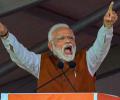
'Modi remains the most popular politician in India; the BJP's organisational and fundraising prowess is considerable; and the Opposition, while newly collaborative, has no leader or clear economic messaging as of yet.'

Poor land-use planning, indiscriminate approvals of building plans and the absence of disaster-risk assessment in urban design have resulted in what experts term concentrated concretization, predisposing cities to disaster risks

We take a look at Time magazines top world leaders.

The government is following a path where it will not be irresponsible or profligate with public money but will intervene in the interest of the poor
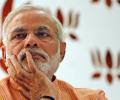
The next general election is more than three years away. Yet, the Centre appears to be reluctant to take any bold move that might annoy influential sections of the electorate.

Paris attacks took the centre stage at the G20 Summit on Sunday with Prime Minister Narendra Modi calling for a united global effort to combat terrorism as world leaders joined a clarion call to eliminate ISIS network.

The Modi government's array of economic policy has been impressive.
.jpg)
Modi government has taken some interesting policy decisions in the 100 days since the time he met President Pranab Mukherjee to present his claim as Prime Minister of the world's largest democracy, says Tanmaya Nanda.

Single window clearances for realty must.

The new numbers did not apparently pass consistency checks with production, inputs, or movements in the National Stock Exchange.
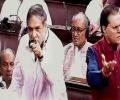
The main opposition party alleged "trampling" of democracy by the BJP-led government which hit back by reminding that Congress had "butchered" democracy by misusing Article 356 about 100 times.

There is a link between objectives and commitments.

Better stick to equity diversified funds, says Larisssa Fernand

Seeking a peaceful and secure neighbourhood amidst threat of terrorism and extremism, India and Kyrgyzstan on Sunday signed four agreements including one on bolstering defence cooperation and holding annual joint military exercises.

Against a turbulent and uncertain background, Budget 2017-18 hewed a steady, forward-looking course, says Shankar Acharya, former chief economic adviser to the government.

'100 Fayazs will bring a change in Kashmir, that's why they don't want a Fayaz.'


With a sole mandate of inflation targeting, RBI wears many hats.

This is the joint statement issued by the ministry of external affairs on the visit of US President Barack Obama to India.

'As of now, it seems like they want to tread the Vajpayee line, but the central government has to create trust.' 'It has to be vibrant and unambiguous.'

The onus is on you to reject financial products that don't suit your needs.

Over 20 political parties, except the Biju Janata Dal and the Communist Party of India-Marxist-led Left Front, took part in the massive rally.
Are we adopting an idea whose time has come and gone? My feeling is, yes, says ex-banker C Joseph Chacko in the fourth article of the series on inflation targeting.

'This is not a Sanjay Baru or Natwar Singh type of book. It's not a memoir. It's not a book to reveal conversations, real or imaginary. This is not a book to position myself at the centre of the world.' Jairam Ramesh on his stint as environment minister.

The derivatives expiry on Thursday is also expected to add to the volatility.
Soon after the BJP lost the 2004 election, the stockmarkets went into unprecedented free fall. Then SEBI Chairman G N Bajpai reveals how his firm handling of the situation restored confidence and soon the markets were back to doing what they do best -- make money. A revealing excerpt from his book, A Game Changer's Memoir.
Chief economic advisor Arvind Subramanian discusses the Budget, goods and services tax, Centre-state relationship and larger issues facing the economy

Instead of a consumption stimulus the government must address the NPA issue with a war footing and invest in infrastructure, affordable housing and exports, says Sanjeev Nayyar.
A brief report card on Modi's ministers.
Finance Minister Arun Jaitley should not drop the ball on continuing the battle against black money and move towards digital transactions to reduce the preponderance of cash in the economy, says A K Bhattacharya.

However, he refrained from speaking on Mexican immigrants and also declined to repeat his frequent promise to force Mexico to pay for the wall.

There is much work to be done to design a good GST.
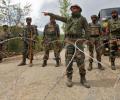
The RSS chief's comment that if war broke out, the military would not be ready for at least six to seven months is correct as it faces a shortfall in training and alertness and an even greater lack of funds for defence preparedness, notes Ajai Shukla.

In a recent lecture, RBI governor Raghuram Rajan dished out some frank advice -- don't get into 'jugaad', instead try for the long haul. Only that will sustain in the long-run.

Pranjul Bhandari, Chief India Economist, HSBC, speaks about a range of issues ranging from inflation, to how Goods and Services Tax and land acquisition bills can help India hit double digit growth, and her impressions about economic growth in the last one year after Narendra Modi took over as India's Prime Minister.
